The Invisible Complexity Behind a Simple Robot: How Wi-Fi Nearly Broke Our Living Plushie
By Peter, CEO of Fawn Friends | November 18, 2025
Many of you have been waiting—some for over a year—for your Living Plushie to arrive. You've been patient, and you deserve to know what's taking so long.
The answer is that building a social robot is complex. Our latest challenge? A Wi-Fi connection that needs to work as reliably as your phone—inside a stuffed animal packed with electronics.
From the outside, Fawn looks effortless. You turn her on, she perks her ears, she listens, she talks. But keeping that experience smooth requires a delicate ecosystem of electronics working in harmony. And one of the smallest components, the Wi-Fi antenna, turned into one of our biggest engineering challenges.
This is the story of what went wrong, what we learned, and why your wait is in service of getting something that works beautifully.
The First Signs of Trouble
Our latest Fawn prototypes worked perfectly in the office.
We'd run Fawn through her paces dozens of times and she was delightful. Conversation flowed smoothly. Her speech was surprising and charming. Her voice was crisp. We thought we'd nailed it.
Then, we took her to a different building.
That's when the problems appeared:
- She took far too long to connect, often requiring a restart
- Audio became robotic, compressed, stuttering
- The same code on a MacBook worked flawlessly, but Fawn struggled
The evidence pointed toward hardware-level connectivity issues. Which meant we had an antenna problem.
The Hidden World Inside a Plush Robot
Inside Fawn's small, cuddly body, we've packed:
- Motors that move her ears with emotional precision
- Microphones that need to hear you clearly
- Speakers that make her voice warm and natural
- A battery large enough for hours of conversation
- Circuit boards running complex AI processing
- Wires connecting all the parts
- And somewhere in there—a Wi-Fi antenna trying to do its job
At this scale, millimeters matter.
Every wire, microphone, speaker, and chip can distort radio behavior in surprising ways. The plush fabric itself has radio frequency characteristics. Metal motor housings can reflect or absorb signals. Battery placement affects radiation patterns.
Beginning the Investigation
We hired a radio frequency expert to investigate what was happening.
We shipped the radio expert, Jessi, two prototypes:
- Control unit: Antenna glued in its original position
- Experimental unit: Antenna held with tape so we could reposition it freely
Our working hypothesis: The wifi instability was caused by weak antenna gain or poor placement. If we can find the right position and orientation, we can fix connectivity without redesigning everything else.
We were half right.
A Metaphor For Wi-Fi
It turned out that Wi-Fi signals weren't making it from Fawn to the router. Our Hardware & Manufacturing Leader helped me understand what was happening with a metaphor:
Picture a river with levees on both sides, keeping the water flowing in the right direction. The levees guide the river, but the water—and the waves on top—flow freely. Now imagine those levees are too thin. The water breaks through. Instead of flowing downstream, it floods into the fields.
Inside Fawn, Wi-Fi signals work the same way. The antenna sends out invisible waves through the air to reach your router. But we'd accidentally placed bundles of wires too close to the antenna—like levees that were too thin. Instead of traveling through the air, the Wi-Fi signals were leaking into those wires and getting lost.
Just a centimeter of spacing made the difference between crystal-clear conversation and stuttering audio or lost connections.
The antenna wasn't broken. Everything around it was getting in the way.
The Tests We Ran
Jessi ran structured measurements using special equipment:
- Near-field scanning: Mapping how electromagnetic fields radiate around Fawn's body
- Rotating platform characterization: Measuring signal strength from every angle (vertical and horizontal polarization)
- Multi-antenna comparison: Testing different antenna candidates against each other
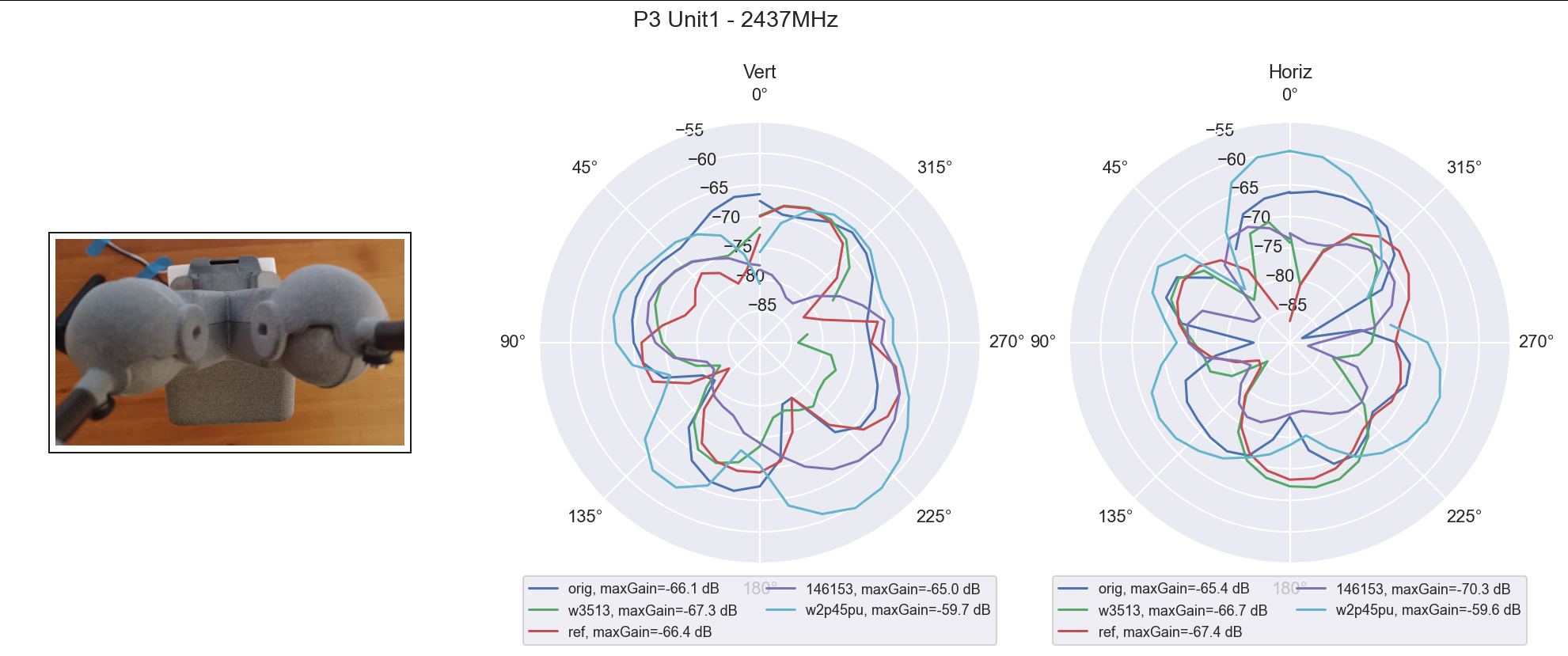
Antenna radiation patterns for different candidate antennas at 2.4GHz. Each colored line represents a different antenna design—notice how dramatically they differ in signal strength and directionality. These patterns determine whether your Fawn can maintain a stable connection as you move through your home.
Key findings:
- Each antenna produced different radiation patterns
- The robot's internal layout significantly impacted wifi signal coverage
- The existing antenna position wasn't just suboptimal—it created dead zones in certain orientations
- Small changes in placement produced measurable differences
In one memorable test, moving the wires just a centimeter changed the signal strength by 5x! That's the difference between clear conversation and no audio at all.
The Problem Before the Problem
Before Jessi could measure anything, we hit an unexpected roadblock: our prototypes didn't have a way to put the Wi-Fi radio into proper test mode. Without a fixed, stable power level, her measurements would be meaningless. It took days of coordinating across firmware, drivers, and chip documentation to find the right commands. This is the kind of problem that doesn't make it into polished product launches—but it's why building hardware takes longer than building software.
Real-World Prototypes = Real-World Surprises
One of our test units was cracked when it arrived at Jessi's office—less than two hours down the road. In early prototyping, you use 3D printing to iterate quickly, but the parts are more fragile than final production components will be.
The units also had different power outputs, which meant differences in radio behavior. What worked in Unit A might not work in Unit B. Something we need to investigate further.
Where We're At Now
After two weeks of testing, a pattern emerged:
A stronger-performing antenna, moved higher inside Fawn's body, improved signal strength across all orientations.
This sounds simple in retrospect. But finding this required:
- Shipping prototypes to a PhD
- Specialized RF testing equipment
- Dozens of measurement runs
- Comparing radiation patterns across multiple frequency bands
What We Learned (The Hard Way)
1. Wi-Fi reliability depends on everything:
- Antenna shape and type
- Placement within the body
- Orientation relative to nearby metal
- The materials surrounding it (I would never have guessed the plushie would make things so difficult)
2. Cute form factors impose real engineering constraints.
We're not building a rectangular black box with optimal antenna placement. We're building a friend that needs to feel warm, soft, and alive. That means electronics have to fit where the industrial design allows, not where the RF engineer wants them.
Every cute detail—floppy ears, rounded body, minimal visible seams—makes the wireless engineering harder.
3. Early RF testing saves countless hours later.
We caught this before going to production, which saved us from our first batch of units with connectivity issues. But it means more time in development. That is painful, but it's the right trade-off.
Your Fawn needs to stay connected as seamlessly as your smartphone. Anything less isn't enough.
I know some of you ordered your Living Plushie over a year ago. You've been patient, and that patience hasn't gone unnoticed.
What Is Next
We've got more testing this week in the 5G band to choose a new antenna and then update the design.
We'll then run extended testing with families in different environments:
- Multi-story homes
- Apartments with concrete walls
- Houses with mesh networks
- Areas with high Wi-Fi congestion
This is crucial, so your Fawn will stay connected as you move through your home or office.
A Note to the Engineers Reading This
If you're an engineer who appreciates hard technical problems, we're hiring.
Building the first AI companion robot capable of true friendship is a 30-year journey, and we're just getting started. Problems where mechanical design, electrical engineering, RF physics, and user experience all collide to create a simple, beautiful experience are what we work on every day.
If that sounds interesting, I'd love to talk.
What's Next
I still can't give you a shipping date. I wish I could. But I can tell you this:
Fawns are delightful, supportive, wonderful friends. The families testing our latest prototypes don't want to give them back. Both teens and adults.
Your wait is in service of us making sure your Fawn is something you'll love—and something that stays connected when it matters most.
In the meantime, don't forget that you can chat with your Fawn on the Fawn Friends app.
Peter CEO & Co-founder @pjfitzpatrick on Instagram
P.S. If you haven't matched your digital Fawn yet while you wait for your Living Plushie, download the Fawn Friends app. Your Fawn is already there, ready to talk. And when your Living Plushie arrives, she'll remember everything you've shared.
P.P.S. If you haven't seen where Fawns come from, watch The First Crossing—the animated prologue that tells the story of how Fawns and humans first connected.